
Does Princess Charlotte have more opportunities to be able to go further in netball than other girls her age?
It’s brilliant to see another young girl enjoying netball, and when that young girl happens to be Princess Charlotte, it gives our sport a little extra attention too! After representing her school in netball matches, Princess Charlotte has also reportedly joined a competitive netball team outside school, too! This has raised the question of whether your educational background can affect opportunities in netball.
How do opportunities differ coming from different educational backgrounds?
Many people will assume that privately educated children will automatically have a head start. So imagine there are 2 equally talented, equally able children that play netball, however one attends an independent school and the other attends a state school. One of those children could benefit from up to 5.5 hours of sport a week, specialist netball coaching, regular training and fixtures, high-spec facilities and plenty of opportunities to compete. The other child may take part in just 2 hours of sport per week, and then only play netball occasionally during those PE lessons or play once a week at the school’s extra-curricular netball club. Of those two players, who do you think is likely to progress faster?
We’ve taken a look at where professional sports-people start their journey, and the opportunities that private schools, state schools, and grass roots netball clubs can give somebody. With all the data and research we’ve conducted, we’ve concluded that enjoyment and passion is what’s vital to a player progressing, and that can be down to the environment, coaching, friends and personal passions, not necessarily where you play.
How difficult is it to become an elite sportsperson, and does background influence opportunity?
So, what does ‘reaching the top’ actually look like?
In England, there’s over 1.3 million people that play netball.
Netball’s elite domestic competition is the Netball Super League (NSL) features just 8 clubs. Each squad is capped at just 10 players.
= just 80 elite spots in the UK’s best netball competition.
Basic maths = 0.0062% of the 1.3m netballers in the UK are professional netballers. Meaning there is approximately one NSL place for every 38,750 people who participate in netball.
Those statistics might sound daunting, but being in that 0.0062% isn’t the only measure of success. We’ll come back to that later!
Professional Sportspeople – where did they start?
There isn’t currently comparable published data covering the educational background of every Netball Super League player, so to understand whether education and elite sport can be connected more broadly, we can look at other sports.
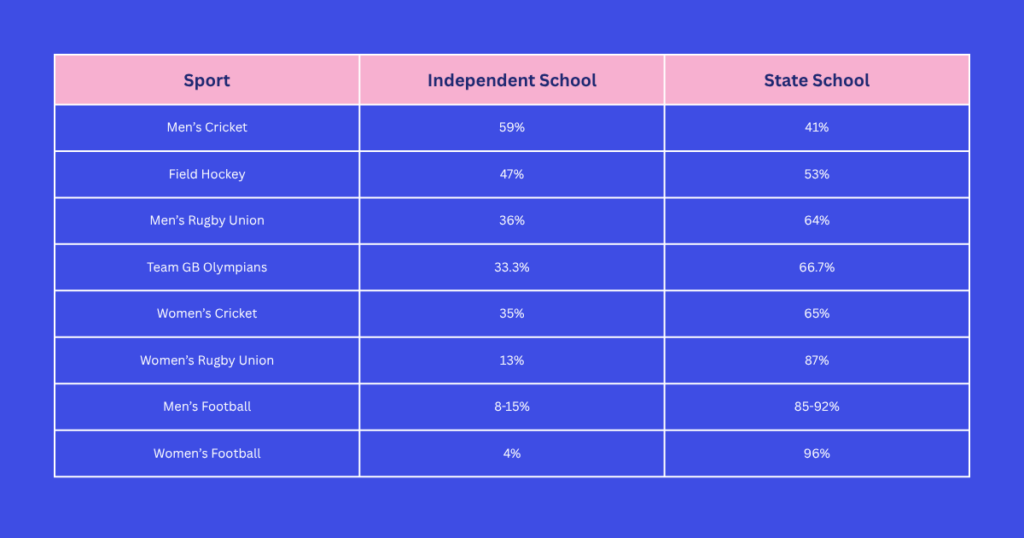
Considering just 7% of the country are privately educated, a proportionately large percentage of professional sportspeople have come from private education. So, for the 93% of children that attend state schools and those same opportunities aren’t provided through school, where else can children find them?
Grassroots!
For a child who doesn’t have lots of netball opportunities at school, joining a local club can be a brilliant place to start. Princess Charlotte reportedly joining a netball club outside of school demonstrates something that applies regardless of educational background: if a child enjoys netball and wants to play more, a local club is a natural next step! As mentioned, just 0.0062% of netballers play professionally, meaning the other 99.9938% of us play purely at grassroots, amateur, or recreational level!
Joining a grassroots club doesn’t mean a child has to have ambitions of becoming an England player, but if they do discover that ambition, there is a pathway available. Joining a grassroots netball club will give you a player similar experience as those playing for their independent school. As well as their elite/competitive teams, many local Junior netball clubs will also offer relaxed, non-competitive sessions for children who want to play for fun and fitness, without the pressure of weekend matches. For players just starting, or wanting to gain confidence, this is one of the best ways to start.
Junior clubs give children the opportunity to play regularly, learn from experienced and passionate coaches, play competitive matches and develop alongside other players who also love the game. For players who want to see how far they can progress, there is a pathway.
Netball pathways. Different opportunities, same possibilities.
For players who want to see how far they can progress, there is a formal England Netball Performance Pathway. A player might first develop through school netball, a local grassroots club, or a mixture of both, with these environments offering different levels of coaching, competition and exposure. However, once a player is identified for the performance pathway, the route merges, so where you started doesn’t matter anymore.
So while a player’s educational background may affect the opportunities available to them early on, their school is not the pathway itself. For players who do not have regular competitive netball available through school, grassroots clubs can therefore provide an important route into the same performance system. If the goal is NSL or England Netball, no matter what educational background a player begins, the route will quickly merge into the same pathway.
Take a look at the typical pathway to playing professional netball.
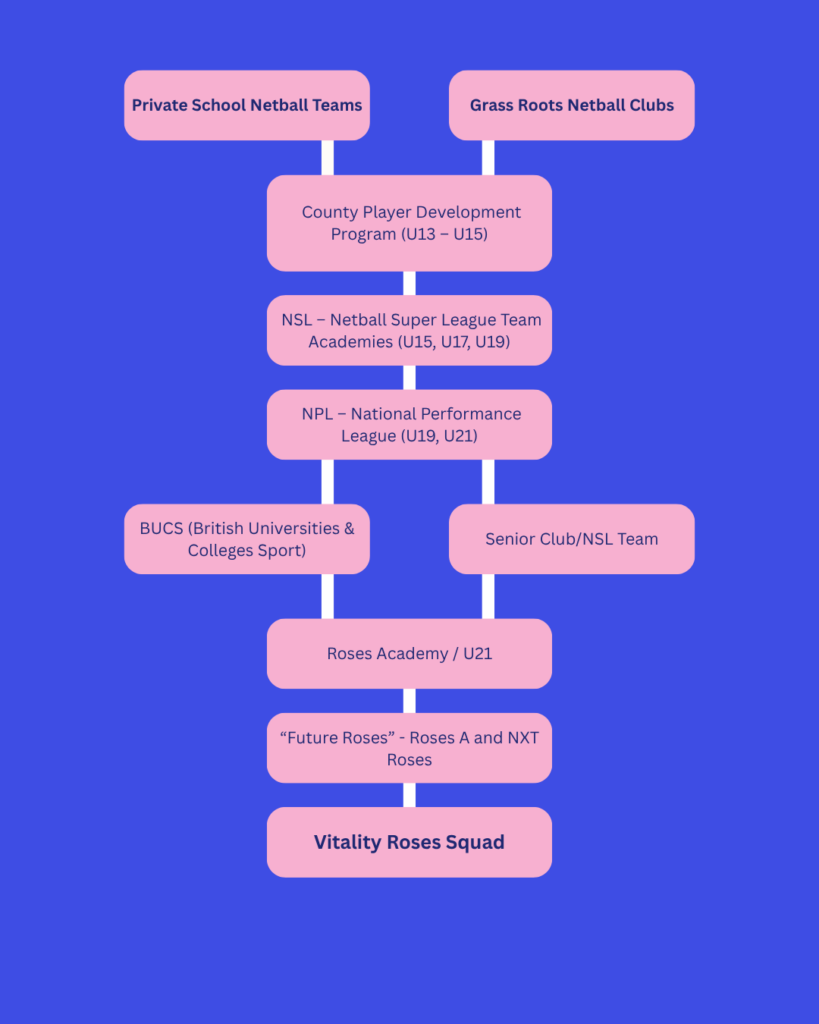
University can be an important development environment, but it isn’t a compulsory stage of the pathway. Our review of current NSL player biographies suggests that between 70%-80% of NSL players attended/attend University.
Regardless of State vs Privately educated players, almost all of NSL and Vitality Roses players have gone through the structured performance pathway.
Should ‘reaching the top’ be the measure of success?
Just 000.62% of netballers in the UK play professionally and achieving that is obviously a huge success. However, ‘success’ is deeply personal and is measured by how you individually define and value your own goals. What would success look like for Princess Charlotte? Elite sporting success does run in the Princess’ family, but for Princess Charlotte, success might simply mean enjoying playing, improving, feeling part of a team, making friends, or winning a match!
The benefits of sport are never ending; friendship, confidence, movement, teamwork, and belonging are the reasons we go back every week, regardless of the level we play at! Finding a group of friends who share the same interests, enjoying and maintaining a hobby, playing into your 30s, 40s, 50s and beyond, prioritising yourself, keeping fit and healthy and having enjoyment and passion in the game, are all huge successes and should be labelled as such, too!
Opportunities matter because children need the chance to discover what netball and ‘success’ can mean for them.
For one player: grassroots, pathway, NSL, Roses.
For another player: grassroots, friends, weekly netball for the next 40 years!
Both started and continued because of the opportunity and passion to play.
Should ‘reaching the top’ be the measure of success?
One thing is for certain, Princess Charlotte playing netball is something to celebrate! If Princess Charlotte encourages more girls to pick up a netball, or ask their parents to join a club, then the percentage of girls benefitting from friendship through netball, learning teamwork, gaining confidence and feeling part of a community, is the only number that really matters.
Want to play netball with us?
You can find your nearest league by typing in your city or postcode in our ‘find your nearest league’ search bar at the top of our website.
Find out more about our leagues
What Netball position are you?